What Does Ferric Sulphate Reveal About Martian Hydrothermal Systems
Key Takeaways
- Understand the main symptoms and warning signs.
- Review common risks and prevention options.
- Learn when to seek professional medical advice.
Characterization of Ferric Hydroxysulfate on Mars and Implications of the Geochemical Environment Supporting Its Formation
Ferric sulphate minerals on Mars provide a chemical fingerprint of past oxidizing and acidic environments shaped by hydrothermal activity. Their occurrence in sulfate-rich terrains indicates that ancient Martian waters once hosted complex redox reactions involving iron and sulfur. The mineral’s stability under low pH and oxidizing conditions marks it as both a geochemical indicator and a potential record of transient aqueous systems. The study of ferric hydroxysulfate assemblages thus reveals not only the planet’s aqueous evolution but also the environmental constraints that may have influenced its habitability.
Ferric Sulphate as a Geochemical Indicator on Mars
The detection of ferric sulphate across Martian terrains has reshaped views on the planet’s mineralogical diversity. Its presence signals oxidation processes acting on iron-bearing minerals, offering direct evidence of acidic water-rock interactions in Mars’ geological past.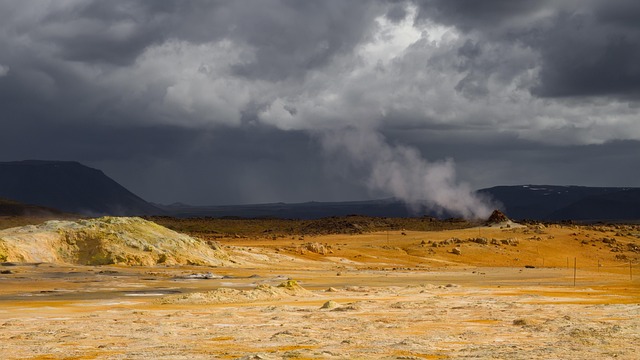
The Significance of Ferric Sulphate in Martian Mineralogy
Ferric sulphate forms when Fe²⁺-bearing minerals undergo oxidation in acidic solutions, leading to ferric ion precipitation with sulfate anions. On Mars, such reactions likely occurred where volcanic gases interacted with surface or subsurface water. The mineral’s occurrence within layered deposits implies episodic wet conditions rather than continuous aqueous exposure. Variations in ferric sulphate composition—ranging from hydrated to basic phases—reflect local fluctuations in temperature, pH, and redox potential.
Spectroscopic Identification and Remote Sensing Evidence
Orbital spectrometers, including those aboard Mars Reconnaissance Orbiter, have identified ferric sulphate through diagnostic absorption bands near 0.43 µm and 0.9 µm. Rover-based instruments later confirmed these findings at ground level, linking spectral signatures to specific mineral textures. Comparison with terrestrial analog spectra from acid-sulfate environments enhances confidence in identification accuracy. Mapping data show that ferric sulphate is spatially associated with sulfate-bearing sedimentary units, particularly in regions like Meridiani Planum and Valles Marineris.
Hydrothermal Processes and Their Role in Ferric Sulphate Formation
Hydrothermal systems represent one of the most plausible mechanisms for ferric sulphate generation on Mars. These systems drive fluid circulation through basaltic crust, dissolving metals and sulfur species before precipitating secondary minerals during cooling or evaporation.
Thermodynamic Conditions Favoring Ferric Sulphate Stability
Ferric sulphate remains stable under low pH (typically below 3), oxidizing conditions, and moderate temperatures between 25°C and 200°C—parameters consistent with hydrothermal alteration zones. Solubility equilibria between Fe³⁺ and SO₄²⁻ dictate the precipitation sequence from solution to solid phase. As temperature decreases, metastable phases such as coquimbite can transform into more stable hydrated forms like jarosite or rhomboclase, recording cooling histories within hydrothermal veins.
Hydrothermal Fluid-Rock Interactions on Mars
When sulfur-bearing fluids percolated through basaltic crusts rich in olivine or pyroxene, oxidative leaching mobilized Fe²⁺ ions that later combined with sulfate species to form ferric sulphates upon oxidation. Elemental sulfur oxidation further acidified these fluids, enhancing metal solubility and sustaining mineral formation cycles. Secondary mineralization patterns observed by rovers suggest multiple episodes of fluid infiltration followed by evaporation or freezing events within ancient hydrothermal conduits.
Implications for Martian Geochemical Environments
The spatial association between ferric sulphates and other acid-sulfate minerals provides a framework for reconstructing paleoenvironmental gradients on Mars. These assemblages trace transitions from deep hydrothermal alteration to near-surface evaporitic deposition.
Acid-Sulfate Alteration Zones as Tracers of Past Hydrothermal Activity
Assemblages combining ferric sulphate with jarosite or alunite point toward sustained acid-sulfate alteration regimes indicative of active hydrothermal discharge zones. Such mineral pairs denote strong redox gradients between ascending hot fluids and cooler surface waters. Stratigraphically, they mark boundaries where hydrothermal alteration gave way to evaporitic sedimentation as water activity declined.
Environmental Constraints Deduced from Ferric Sulphate Assemblages
Phase stability diagrams constrain formation conditions to environments characterized by low pH